https://www.ted.com/talks/thomas_hellum_the_world_s_most_boring_television_and_why_it_s_hilariously_addictive
Analysis of Thomas Hellum's Slow TV TED Talk:
In this TED talk, Thomas Hellum presents a current TV fad in Norway in which he played a role. He explains to his audience why Slow TV is interesting/addictive. Hellum starts by explaining how a D-Day invasion special that would last the whole of the invasions anniversary, transformed in a 7 hours long train ride broadcasted across Normandy. He explains how the idea was presented to the station and finally the set-up of this first Slow TV broadcast. The train ride lasted a whole of 7 hours and attracted an incredibly spike in viewers during the broadcast time. Hellum shows how social media played a role in bringing people together in their discussion of the train ride.
After the train ride Hellum moves on to the main focus of his presentation where he explains why he believes Slow TV is so popular with the people in Norway. He begins to speak of the boat ride which would go from one end of Norway to the other. The course had been done countless times before and have even have the same Norway broadcasting channel on it in the past, however, this time would be a full viewing experience of over 1080 hours. Hellum showcases the setup behind this giant endeavor before he begins to break down why people gathered in such mass to view and see this ship sail across Normandy in a slow, and uneventful process.
On the Boat:
1) Hellum talks about how, with such a long and boring ride, people make their own stories. Theres an national appeal to seeing your own country and its people broadcasted across Normandy for 1080 hours. People came out to see themselves on TV and wave their Norwegian flag. The whole of the experience was nationally unifying, pulling over 20% of the Norwegian population to view the program at some point of its airing.
2) The emotional appeal of Slow TV was apparent too in Hellum's talk. He discusses how people would watch the coastal camera on board the boat, pointing out the concern showed on social media by some people when they witnessed a certain man on horseback fall off during the broadcast. Hellum also presents that Slow TV is emotionally calming because of its lack of story. No characters or plot, only calm and consistent images which allow the viewer to create their own stories at their own paces. "When people smile, it might be a good idea" -Thomas Hellum (in this TED Talk)
Soon Hellum moves on to discuss the other broadcasts done as Slow TV. From additional train rides during the 4 seasons, a knitting channel, and even the hours spent watching men in the woods cutting logs and then burning them for hours to follow. Overall, Hellum presents the experience of Slow TV being one that is driven by the viewer while maintaining emotionally calming an atmosphere.
One Final Point on Hellum's Talk: The scene of a barn on the coast and a cow on the shore.
In his final minutes Hellum shows a clip from the summer in which a coast line barn is shown for around half an hour. He discusses step by step how the viewer processes this rather boring image. He explains how it is emotionally soothing yet soon lets you make your own story. Aside from the national connection Slow TV brought to Norway, though both social media and social gatherings, Hellum explains how things like this scene allow the viewer to make their own personal perception of the video.
Over the course of his talk, Hellum explains the appeal of Slow TV with reference to its ability to bring together people, sooth emotions, and allow the viewer to create their own stories without being forced to watch a definitive story. He shows a variety of social media posts and TV coverage which support his conclusions on why Slow TV is so interesting yet so boring for its viewers. The variety of evidence he provides supports his emotional explanation (is the man who fell off the horse ok?).
Personally, I've enjoyed things like Hellums Slow TV. While i cant think of any apparent examples on American TV. I can think of things like this that I'll put on for hours just to pass time and relax. https://www.youtube.com/watch?v=wI__53kBBKM
I really ejoyed just the short clips Hellum showed and would honestly watch this channel given the opportunity. Even though he constantly refers to his Slow TV as boring I personally felt it would be incredibly interesting to watch or at the very least leave on for hours in a room while you work on something else. My favorite kind of entertainment is the kind that can be enjoyed in ambiance.
Sunday, January 24, 2016

Sunday, January 10, 2016
The Hero in Double Indemnity
There is almost certainly only one heroic character in Double Indemnity. The only possible answer is that of Barton Keyes.

T Ill spend the majority of this answer discussing why Barton Keyes is the only understandable notion of a hero in Double Indemnity. Friend to the Walter Neff, Keyes and Neff spend much the movie talking things over. Even before the case of the double indemnity it is clear the Keyes is a sort of icon for Neff. keyes, even the face of his boss' meltdown, seeks to correct the attitude he takes towards policy holders. Keyes stands up to even figures which should be above his power (his boss, his suspicion that it was more than an accident, and finally Neff's confession) and bravely confronts them.
When Keyes himself convinces his boss to dismiss the case as an accident, he instead takes up the investigation on his own. Keyes risks his own life investigating a potentially murderous case just to keep his boss and company out of a legal battle with Phyllis. While he is guided by his own "gut feeling" his sense of righteous justice is clear in his pursuit of the truth. He may merely work for an insurance company but he has the morals of a hero.

Even when Keyes is faced with his own friends confession of the crime, he remains calm. He almost pities his friend for falling into such an unfortunate trap. As Neff sits recording his confession, Keyes is feels anguish over his friends fate. Keyes was perhaps the most morally upright character in the entirety of the film. While Neff fell to lust, Phyllis, Mr Dietrickson, and his boss all feel to greed, Keyes remained morally upright. Everyone else in this movie had an apparent moral collision, except for Keyes. Throughout tough cases and fallen friends, Keyes remained the only glimmer of decency in Double Indemnity. Anyone who claims another character from the movie was heroic is likely grasping for straws which Keyes himself played a role in.

(Keyes trying to teach Neff his heroic ways)
Sunday, December 13, 2015
A Netflix queue for Fleance. May Banquo RIP.
For starters, I don't have a Netflix account so I'll be choosing shows from all over. I doubt this matters for the blog post but its just a forewarning.
Now since I'm catering this list to Fleance and my assumptions of his personality I need to make some probably inaccurate guesses. So Merry Christmas Fleance! Lets look at some media that should take your mind off your dead father and impending pressure of ruling Scotland!
 |
| "Murderer 3, I will find you."
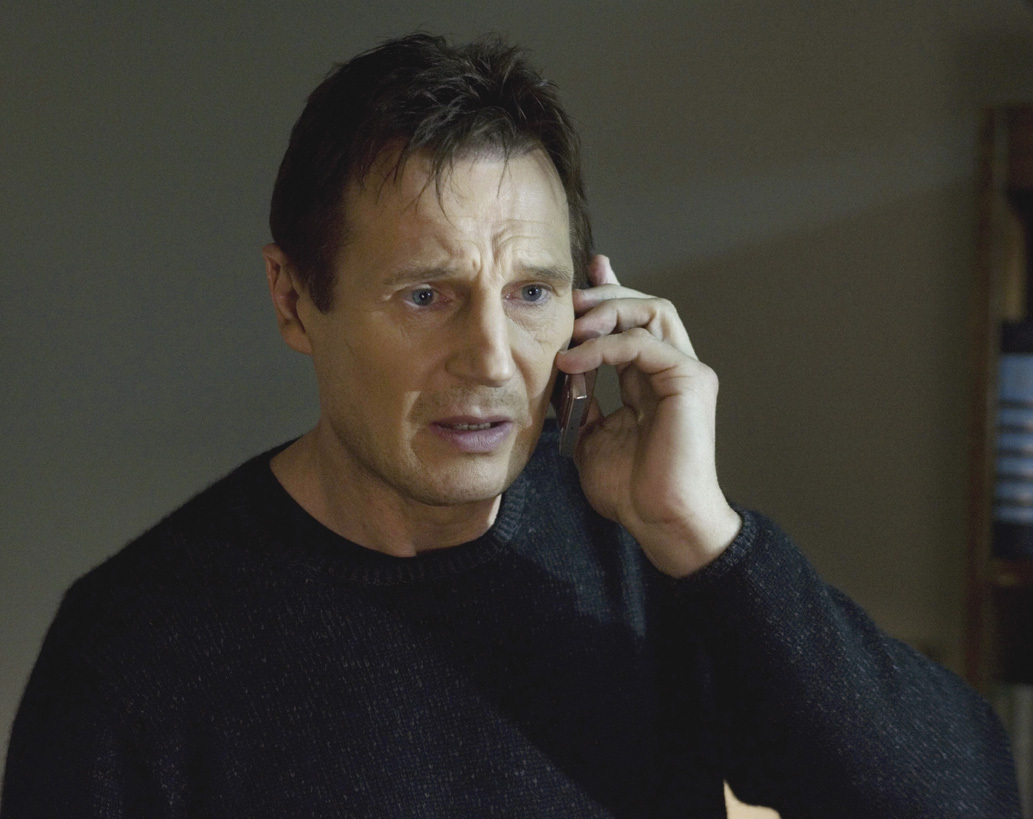
Taken (1,2, and 3 =D) Behold Fleance! This first trilogy of movies should help you get over your definite fear of both criminals and killers! In taken, a father played by Liam Neeson saves his kidnapped daughter from the murderers sent by Macbeth to prevent you from taking the throne. But, in this movie, Banquo will save his son and kill all of the opposing murderers and kidnappers sent by the movies Macbeth equivalent. No doubt you'll enjoy the sequels as well as you watch Liam Neeson and director jump the shark as his character hunts down murderers not twice, but THREE times! Fleance will love this film as a means to keep his mind off the impending pressure of taking the throne under the witches prophecy, as well as, a means to take his mind of his dead father Banquo!
 Seriously shout out to the EE. Seriously shout out to the EE. The Lord of the Rings trilogy! A better movie to summarize Fleance's life has never been made! (except maybe the Macbeth movies). Watch Fleance, as the young Frodo Baggins goes on a long journey across lands much like your own, and, all without a father no less! If Frodo and Sam could do it, then surely Fleance too can resist the temptation of power's corruption and rise above Macbeths example as leader of Scotland. Take the teaching of Frodo fleance and learn that perhaps only with help from a friend will you fully survive the corruption of absolute power. Heres hoping Fleance, that you find your own precious, resist the temptations of Sauron (with witches) and rule Scotland fair and just. Atleast until a sequel comes out.  Star Wars (The Original Trilogy, dont worry i wouldn't do that to you Fleance) Assuming you haven't yet got over your father troubles, maybe this will help! Watch as Luke faces off against the absolute power of the Imperials and the Dark Side (Witchcraft lets be real) only to find out that their biggest baddy is his very own daddy! At least yours died to save you, Luke's was a witch all along! Hopefully Fleance will find some peace in knowing his Dad died a hero. Perhaps the similarities between Banquo and Darth Vader will help Fleance find peace in his rule over Scotland (hopefully). In fact, I'd say Emperor Palpatine and Vader are a lot like a alternate reality where Macbeth convinces Banquo to fully embrace the prophecy and subjugates him under his leadership. Well i hope that helps Fleance rest easy knowing that his father at least died resisting the temptations of evil prophecy.  Home Alone Merry Christmas Fleance! You'll definitely love this one. In Home Alone a young boy evades two criminals (whatever right? you avoided three) and manages torture them the whole time as this child home alone on Christmas Eve sets traps aplenty up for his foes to enjoy. Maybe you'll even be reminded of the run from the murderers you yourself did without parents, until of course the creepy serial killer drive-way shovel-er comes to save you from the murderers. (Take any form but this i beg of thee). In watching this Fleance, you'll probably find yourself rooting for the young boy till the end.  Craigslist Joe Depending on how you look at Fleance's life, you'll see the similarities here. After Banquo is killed, Fleance has to flee his home and essentially everything hes ever known. Well so did this guy whom gave up his whole life, worldly possessions and contacts to begin life from scratch with nothing but the essentials. Like Fleance, this guy has to face the world empty handed and build from the bottom up (until the witches prophecy makes him king of course). As a final film in Fleance's queue, i hope this will raise his faith in humanity as he witnesses some rather flaterring acts of kindness by complete strangers who just want to help a guy without anything to his name. Fleance, I hope you're not emotional. These all may hit close to home. Exeunt. |
Sunday, November 22, 2015
MacBeth's fall from Grace, Witch slapped!
1. Why do people who are not "evil" take the first step into evil? What, for instance, is involved in taking that first step "down the primrose path to the everlasting bonfire" (Macbeth, 2.3)? What are the consequences of the individual choosing evil (particularly the internal consequences)? Use examples from the text to support your opinion.
The transition of good to evil is not so transparent in the real world as it is in stories. Macbeth for example, takes the plunge in hoping to attain higher power by fulfilling the witches prophecy: "I am his Kinsman and his subject, Strong both against the deed; then, as his host, who should against his murderer shut the door, not bear the knife myself" (Shakespeare Scene IV Act 1). Even in Macbeth's contemplation he realizes that his actions to aspire to power would be wrong. However, Lady Macbeth's convincing words and Macbeth's own lust for power would soon drive him to do the deed against Duncan and soon Banquo too. This moment is fairly clearly the beginning of Macbeth's descent into evil as he realizes what he could gain by simply committing a single crime. The situation is surely similar to many real life examples of evil transition. Many leaders in the real world who are known for being evil were likely good before a taste or thirst for power drove them to begin committing evil deeds which would ultimately damn them.
The factors involved with taking the first step, for Macbeth at least, are very plainly displayed. In Macbeth's evil transition it is apparent: "Is this a dagger which i see before me, The handle toward my hand? Come, let me clutch thee" (Shakespeare Scene 1 Act 2). For Macbeth, his first step was taking up this either material or ethereal knife as he settled his mind on killing Duncan to become Cawdors king. For other instances of evil transition. It is likely a similar event which leads to an individual becoming malicious in intent. For a robber, it may be the final decision and purchase of a gun that final deems him as "evil" as he has decided to commit a crime in hopes of gaining something.
Finally, the consequences of choosing evil. Macbeths consequences become apparent directly after his decision to murder Banquo and Fleance: "Which of you have done this? What, my good lord? Thou canst not say I did it: never shake thy gory locks at me" (Shakespeare Scene IV Act III). Not only is Macbeth immediately haunted by the ghosts of his deeds but his brush with Banquo's ghost serves to make him look the part of a fool in front of all the nobleman he worked to impress. In exchange for his evil gains he was faced with directly countered consequences which lead to his social and mental demise. For Macbeth, the internal consequences become apparent in the ensuing madness that grips him during this scene. For other individuals, the consequence is likely the same. Like Macbeth many people would begin to lose their mind in recognition of their own evil deeds. That is the greatest consequence that can befall someone who perpetrates evil; the destruction of their own mind when they realize what they have done for power.
BTW: happy birthday Mrs. Genesky!
The transition of good to evil is not so transparent in the real world as it is in stories. Macbeth for example, takes the plunge in hoping to attain higher power by fulfilling the witches prophecy: "I am his Kinsman and his subject, Strong both against the deed; then, as his host, who should against his murderer shut the door, not bear the knife myself" (Shakespeare Scene IV Act 1). Even in Macbeth's contemplation he realizes that his actions to aspire to power would be wrong. However, Lady Macbeth's convincing words and Macbeth's own lust for power would soon drive him to do the deed against Duncan and soon Banquo too. This moment is fairly clearly the beginning of Macbeth's descent into evil as he realizes what he could gain by simply committing a single crime. The situation is surely similar to many real life examples of evil transition. Many leaders in the real world who are known for being evil were likely good before a taste or thirst for power drove them to begin committing evil deeds which would ultimately damn them.
The factors involved with taking the first step, for Macbeth at least, are very plainly displayed. In Macbeth's evil transition it is apparent: "Is this a dagger which i see before me, The handle toward my hand? Come, let me clutch thee" (Shakespeare Scene 1 Act 2). For Macbeth, his first step was taking up this either material or ethereal knife as he settled his mind on killing Duncan to become Cawdors king. For other instances of evil transition. It is likely a similar event which leads to an individual becoming malicious in intent. For a robber, it may be the final decision and purchase of a gun that final deems him as "evil" as he has decided to commit a crime in hopes of gaining something.
Finally, the consequences of choosing evil. Macbeths consequences become apparent directly after his decision to murder Banquo and Fleance: "Which of you have done this? What, my good lord? Thou canst not say I did it: never shake thy gory locks at me" (Shakespeare Scene IV Act III). Not only is Macbeth immediately haunted by the ghosts of his deeds but his brush with Banquo's ghost serves to make him look the part of a fool in front of all the nobleman he worked to impress. In exchange for his evil gains he was faced with directly countered consequences which lead to his social and mental demise. For Macbeth, the internal consequences become apparent in the ensuing madness that grips him during this scene. For other individuals, the consequence is likely the same. Like Macbeth many people would begin to lose their mind in recognition of their own evil deeds. That is the greatest consequence that can befall someone who perpetrates evil; the destruction of their own mind when they realize what they have done for power.
BTW: happy birthday Mrs. Genesky!
Sunday, November 8, 2015
Analyzing Art through Modern Art Eyes!
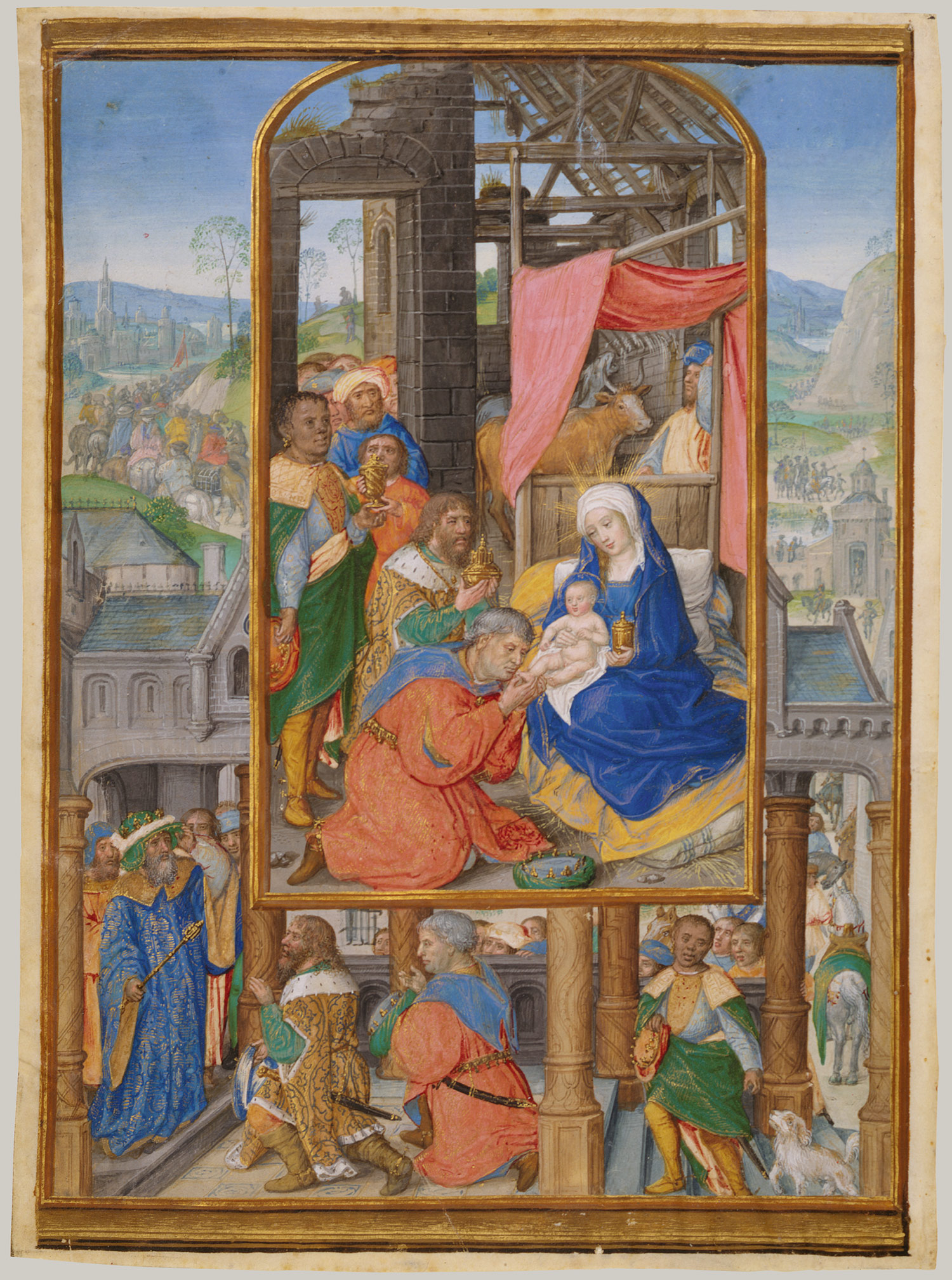
1)Adoration of the Magi, ca. 1520
Attributed to Master of James IV of Scotland
Ink and tempera on vellum; 6 5/8 x 4 4/5 in. (16.9 x 12.4 cm)
Bequest of George D. Pratt, 1935 (48.149.15)
(Below)
"Adoration of the Magi" By Hunter Jamison
A modern recreation of the older piece. Attempting to portray a more modern day message through impressionistic approach to form and interposition within the symbolic placement of the individual figures in the space.
 |
2) The piece was created in the year 1520 likely by "Master of James IV of Scotland". The piece matches many conventions seen in otherwise confirmed arts by the artist and appears to have been created in a time period where the artist was otherwise known to be creating works. Though, the creator of the piece is now a certainty.
"Identified by some with the Netherlandish painter and illuminator Gerard Horenbout, this artist was especially adept at manipulating and expanding the illusionistic effects of manuscript illumination".
3) The piece depicts the magi and their journey to see the Herod. The final bowing and meeting is superimposed over the representative journey portrayed behind the central scene. Emphasis is put onto the Magi's journey through the top left and clockwise to the bottom left through vivid colors not present in the center. This method had been utilized in the past by the artist but never used to superimpose an otherwise hidden theme through color.
4) The artist uses emphasis, contrast, size, color, brightness, position, space, and form all in tandem to convey a singular message of importance that is placed upon the central super-imposed image of a child in the woman's lap. The placement of the magi around and below the child serves to emphasize both the journeys length and the figures importance. Colors are used to emphasize specific individuals around the painting and size is reflective of the individual scene's importance to the artist. Where hazy texture are used to represent farther, more long-ago times in the magi's travels; clear colors and bold lines show the more recent and current stages of the magi's journey. All of this is used by the artist to place an emphasis both and the magi's journey and their final arrival at the paintings central destination.
5) The piece carries a rather apparent meaning. The child in the center, the meeting between him and magi kneeling before him, is super-imposed upon the magi's long journey to meet this holy child and his mother. The length and distance of the magis journey, conveyed using color emphasis, clarity, and relative size to communicate distance and importance, is used as a symbolic representation of the great importance placed in the pieces depicted journey. Like most holy art works created at this time, the piece is painted in tempera paint and uses very familiar styles to convey holy authority and figure. The holy orb and glow which bring emphasis to the child's importance,but, also to this holiness are key to the images final message. The magi, disciples of this holy child, have come from far to see this young icon and his mother. The painting most likely depicts the virgin mother and a baby Jesus, or a scene much like it, bringing special emphasis to the importance of a child which is depicted on a level equal with that of the son of god himself.
Sunday, October 11, 2015
The secret 9th deadly sin is blogging. Freebie Post for 1st Quarter.
Freebie Blog Post. Please Ignore.
Sunday, September 27, 2015
The meaning of my name? Well it would be nice if it was Beowulf.
My Last Name
I have always liked my last name. Even when I was young i thought it sounded nice and professional, allowing me to fit into any scene i wanted to. My first reason for loving it came when I realized Spiderman (Toby Maguire)'s boss was named Jameson (yes with an e but close enough). I loved spiderman and so I felt that through my last name I had gained a sort of connection with the character. Its part of why I have always admired my own last name.Another meaning I hold in my own last name is its origin from Ireland. My family is very Irish and embraces that culture thoroughly. When I was young I learned that the name Jamison means Supplanter, which, is often use to refer to governments or rulers of countries. Having already considered my last name to be "fancy" sounding since I was young, knowing this only reinforced that perception.
The Two Me's
I agree with Anna Quindlen, there are two me's. Or at the very least, there is definitely more than one. I dont believe its inherently negative but people seem to learn through association. So, people don't just know me as "Hunter", to some I may be "Hunter, friend of X" or "Hunter, with his two brothers". Im sure to my siblings friends I'm seen as "X's big brother". It definitely interesting to consider how I may be seen, not as an individual, but as a member of my Father or Mother's family. While I strive to prove myself as an individual im almost automatically considered to be part of whole depending on what someones perspective in knowing me is. Someone from another group may only see me as "one of X's friends" so rather than knowing me for my own name, I am known as someone's friend.
I wonder if this is how Beowulf's friends feel. It can't be easy living in the shadow of Beowulf.
Subscribe to:
Posts (Atom)